Table of Contents
Why Cycle Syncing Your Pilates Practice Matters
I still remember the first time I heard about cycle syncing. At that point, I had been teaching Pilates for nearly a decade and working with hundreds of women. Yet I noticed a pattern. Some weeks they were full of energy, flowing easily through advanced reformer sequences, while other weeks they struggled to even show up on the mat. It wasn’t a lack of discipline. It was hormones.
Your menstrual cycle profoundly affects your energy, flexibility, strength, and focus. Instead of fighting those shifts, cycle syncing teaches you to work with them. When you align your Pilates practice with your hormonal phases, you move smarter, not harder. You recover better, feel more balanced, and reduce symptoms like fatigue, bloating, and cramps.
Understanding the Four Phases of the Menstrual Cycle
Before we dive into the Pilates part, it helps to know what’s happening hormonally each week. Every woman’s cycle is unique, but generally, it follows this four-phase rhythm:
| Phase | What’s Happening | How you feel |
| Menstrual – (1-5 days) | Hormone levels drop, body sheds uterine lining | Low energy, introspective, slower recovery |
| Follicular – (6-14 days) | Estrogen rises, energy increases | Motivated, creative, strong |
| Ovulatory – (15-17 days ) | Estrogen peaks, testosterone boosts | Energised, confident, social |
| Luteal – (18-28 days) | Progesterone rises, energy tapers | Calm, inward, possibly moody or fatigued |
Understanding this pattern allows you to customise your workouts, knowing when to challenge yourself and when to rest. You can explore this in more detail in Cycle-Syncing for Athletes.
Phase-by-Phase Pilates Guide
Pilates during each cycle phase helps you train in harmony with your hormones instead of against them.
Menstrual Phase (Days 1–5): Restorative and Gentle
This is your time to slow down. Think mindful movement rather than calorie burn. I usually recommend mat-based Pilates, with props like a ball or small pillow for support. Focus on breathing, spinal mobility, and gentle core activation.
Try:
- Supine pelvic tilts
- Child’s pose stretch with ball support
- Cat-cow spinal rolls
- Gentle hip bridges
These moves ease cramps, support blood flow, and help you reconnect with your body. You might also pair this with calming yoga poses for PMS relief.
Follicular Phase (Days 6–14): Build and Energise
As estrogen rises, so does your motivation. This is the perfect window for reformer or mat Pilates with added intensity. You’ll notice better endurance and coordination.
Try:
- Pilates hundreds on the reformer
- Standing leg work with resistance band
- Plank variations
- Roll-ups with Pilates ring
This phase is ideal for learning new choreography or setting personal goals. You’re mentally sharp and physically primed.
Ovulatory Phase (Days 15–17): Power and Precision
This is your peak phase. Estrogen and testosterone are at their highest. You’ll feel stronger and more connected to your body.
Try:
- Jump board reformer routines
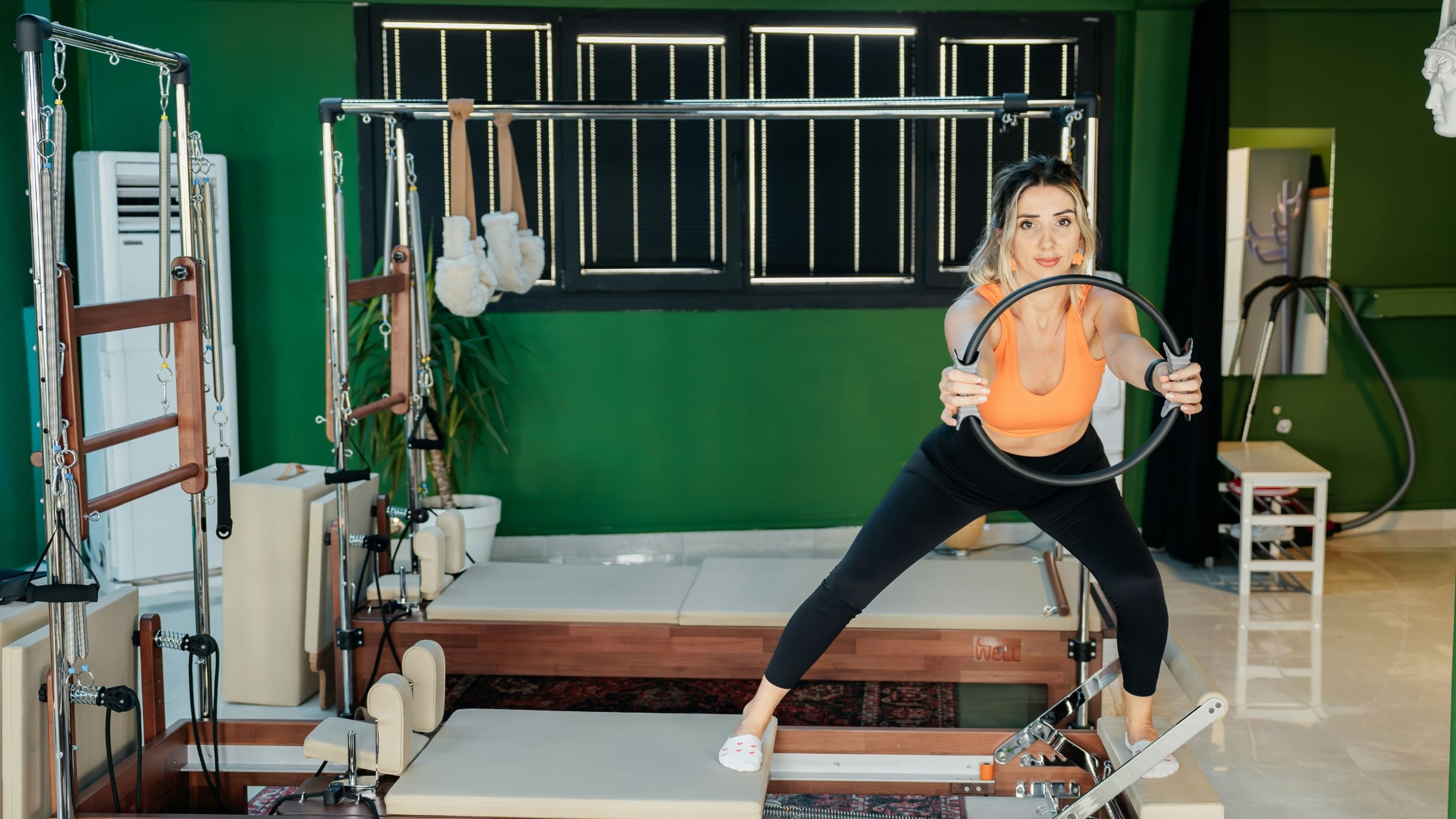
- Side-lying leg series with Pilates ring
- Teaser series for core power
- Standing bar sequences for coordination
Because your ligaments are more flexible due to hormone changes, prioritise alignment and control to avoid overstretching.
Luteal Phase (Days 18–28): Strength with Mindfulness
The luteal phase often gets a bad reputation with PMS, but it’s also a time to channel energy into stability work and slower strength sessions. According to Healthline, focusing on moderate exercises like Pilates, yoga, and mindful strength training can help you stay active without overtaxing your body.
Try:
- Slow reformer lunges
- Wall roll-downs
- Pilates ring inner thigh pulses
- Seated spinal twists
If you feel fatigued, switch to breath-focused or restorative flows. Don’t force intensity. Instead, honour your body’s signals.
How to Use Pilates Props : Ball, Bar, Ring, and Reformer
Props aren’t just accessories, they’re tools to help your body adapt through each cycle phase.
| Prop | Best For | When to Use |
| Ball | Core and support | Menstrual & Luteal |
| Ring | Tone & control | Follicular & Ovulatory |
| Bar | Balance & alignment | Follicular |
| Reformer | Strength & flow | Follicular & Ovulatory |
How It Helps
- Provides stability and gentle resistance
- Enhances muscle activation
- Builds posture and full-body awareness
- Enables progression and precise resistance
I’ve found that alternating props based on my cycle helps me stay consistent and prevents burnout. Some days, that small Pilates ball feels like a lifeline; others, I’m ready to conquer the reformer.
Cycle Syncing Tips for Real Women
Cycle syncing isn’t about perfection. It’s about awareness. These are the habits that have helped my clients (and me) stay balanced throughout the month:
- Track your cycle : Use apps like Clue or Flo to understand your patterns.
- Journal your workouts : Note how your energy and mood shift week to week.
- Listen before you push. If your body feels heavy or inflamed, scale down intensity.
- Fuel your hormones. Eat more protein and complex carbs in the luteal phase and hydrate well during ovulation.
- Prioritise recovery. Pilates is powerful because it’s adaptable. Use that to your advantage.
Faqs about Best Pilates Exercises for Cycle Syncing
1. Can beginners try cycle-syncing Pilates?
Absolutely. You don’t need to be an expert. Start by tracking your cycle and noticing your body’s signals. Then, adjust intensity and style gradually.
2. What if my cycle is irregular?
That’s common. Instead of rigid schedules, focus on how you feel energy levels, sleep, mood and adjust your Pilates accordingly.
3. Do I need all the Pilates props?
Not at all. Start with what you have, such as a mat and maybe a ball or ring. The key is mindful movement, not expensive gear.
Final thoughts
I used to think consistency meant doing the same workout every day. But as I deepened my understanding of the menstrual cycle, I realised true consistency comes from listening, not forcing. Pilates became more than exercise; it became a dialogue with my body.
When you honour your hormonal rhythm, you don’t just move better, you live better. You begin to see rest as productive, movement as medicine, and your body as the wise, cyclical system it’s always been.
So next time you roll out your mat, ask yourself: What does my body need today? That’s where true strength begins.